
blog
insights and updates from the YOM team
Five questions to ask anyone who says "sovereign"
Sovereignty is one word covering several layers. Here are five questions to ask any infrastructure provider, answered for the YOM network, including what is live and what is still on our build list.
 Jeff Outlaw 2026-11-25

Learning to Cook with Fire
Disruptive innovations are often viewed with distrust, and AI is no different. What can be learned from other examples of disruption, and how can we leverage these changes for the best?
Jeff Outlaw 2026-11-22
64 payouts, zero intervention: the night YOM's payouts went automatic
What happened in the first 36 hours after we handed the payout loop over to a contract, and how to verify every transaction yourself.
Jeff Outlaw 2026-11-18
explore
all articles
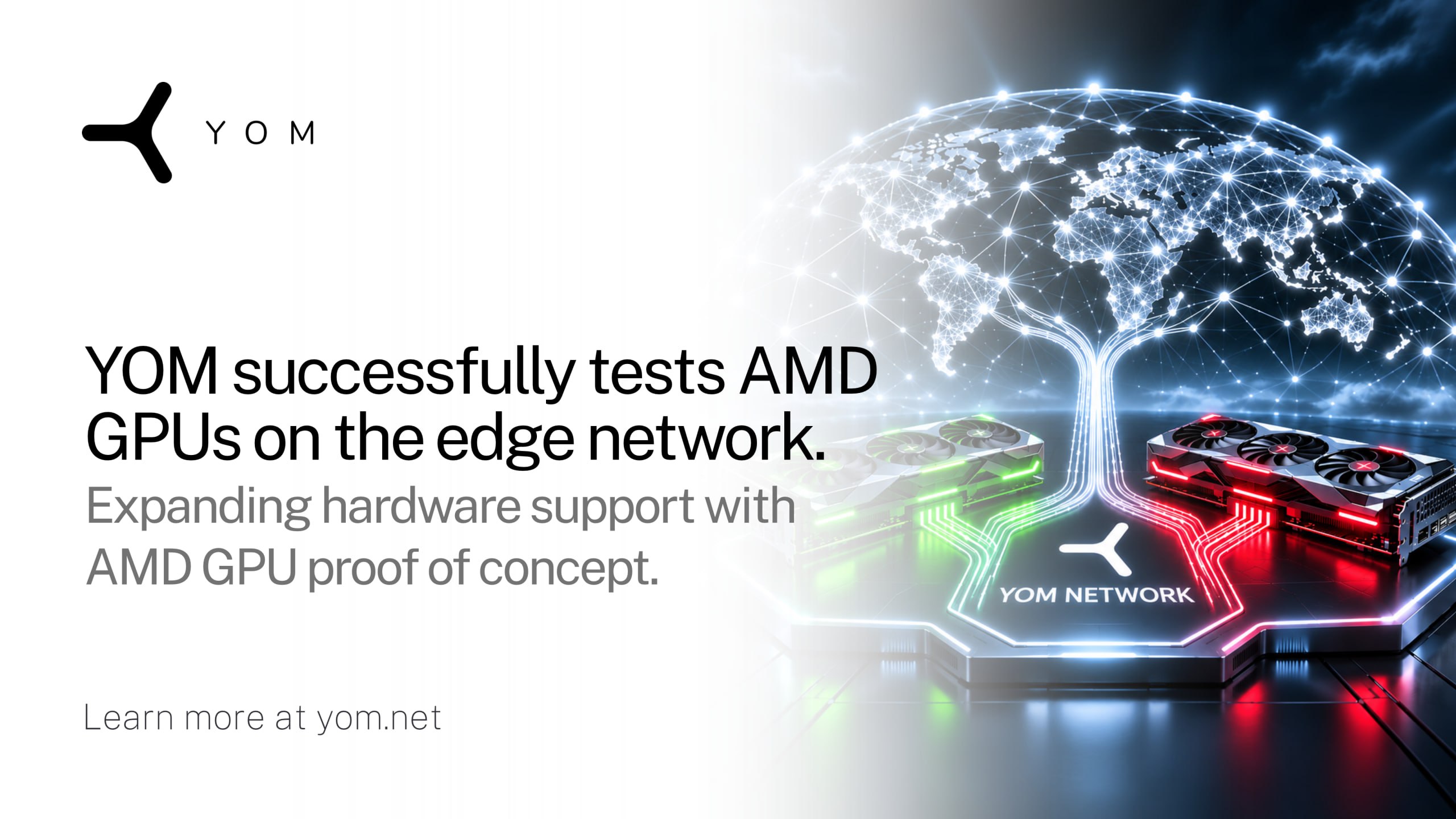
AMD GPUs on the YOM edge network: proof of concept
We ran our edge network on AMD GPUs in a proof of concept. It is not live in production yet. Here is what we tested, what it took, and why a network should not depend on one GPU supplier.
Jeff Outlaw 2026-11-16
27,127 sessions: inside YOM's busiest month yet
Three months of network data, what happens when real players flood the pipes, and how to check every payout and burn on-chain.
Jeff Outlaw 2026-11-12

What San Francisco taught us: everything comes down to access
Notes from a week in San Francisco with Techleap's Gaming Founders Circle: access, pace, and why games belong where players already are.
 Jorrit Velzeboer 2026-11-05
$YOM delisting from MEXC: an update to our community
$YOM will be delisted from MEXC. Here is what happened, what it means for the YOM network, and where $YOM continues to trade.
Jeff Outlaw 2026-10-29

from slots to capacity: every license becomes two
Every license you hold becomes two, every NANO includes two licenses, and a new license costs half the old price. How a NANO, capacity, session fees and licenses work, and what a machine can earn.
Jeff Outlaw 2026-10-23
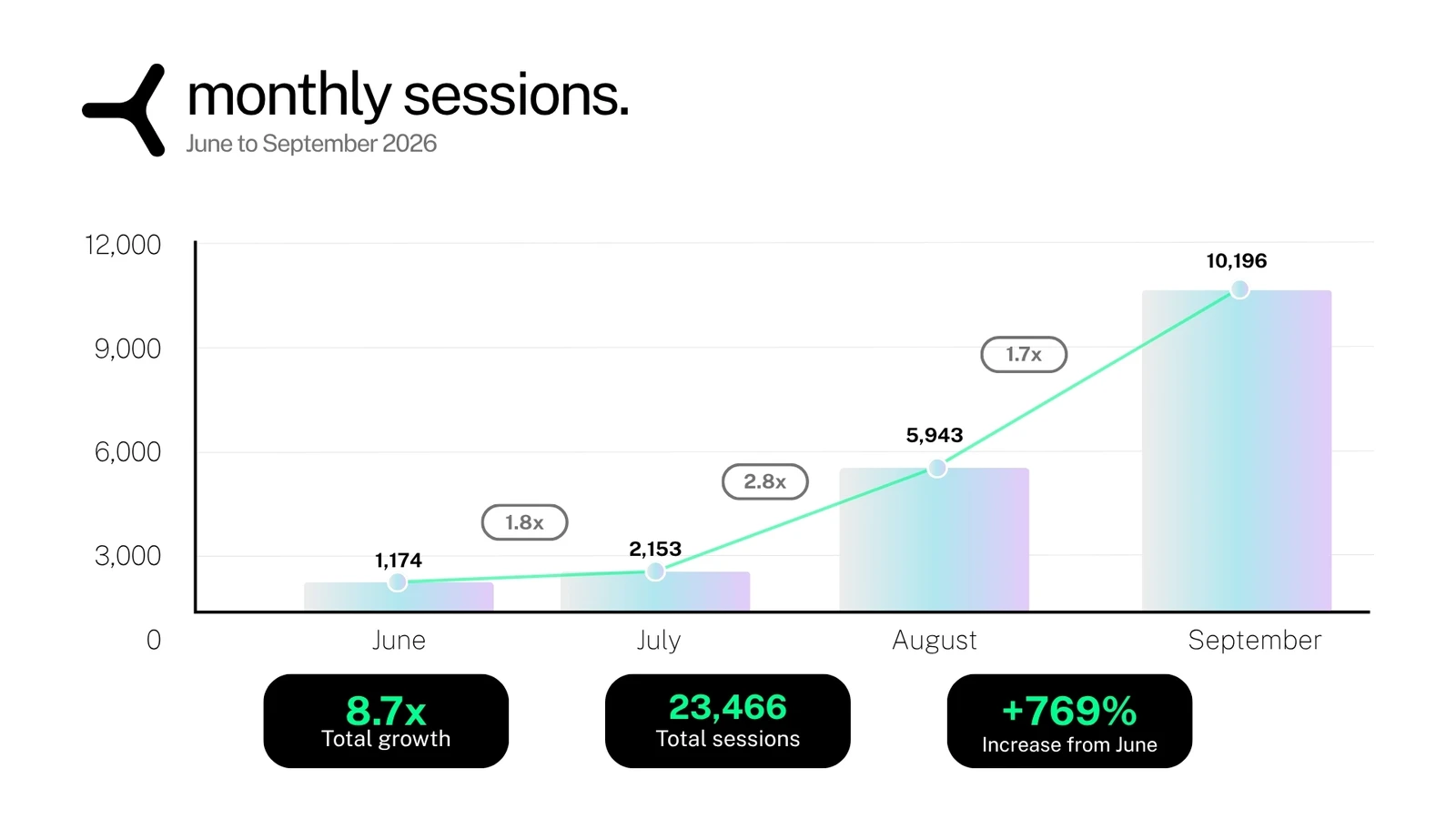
doubling down: four months of network growth
We now have four months of network data, and there's a lot to celebrate.
Jeff Outlaw 2026-10-08
AAA games on telco edge infrastructure: 20 days of results
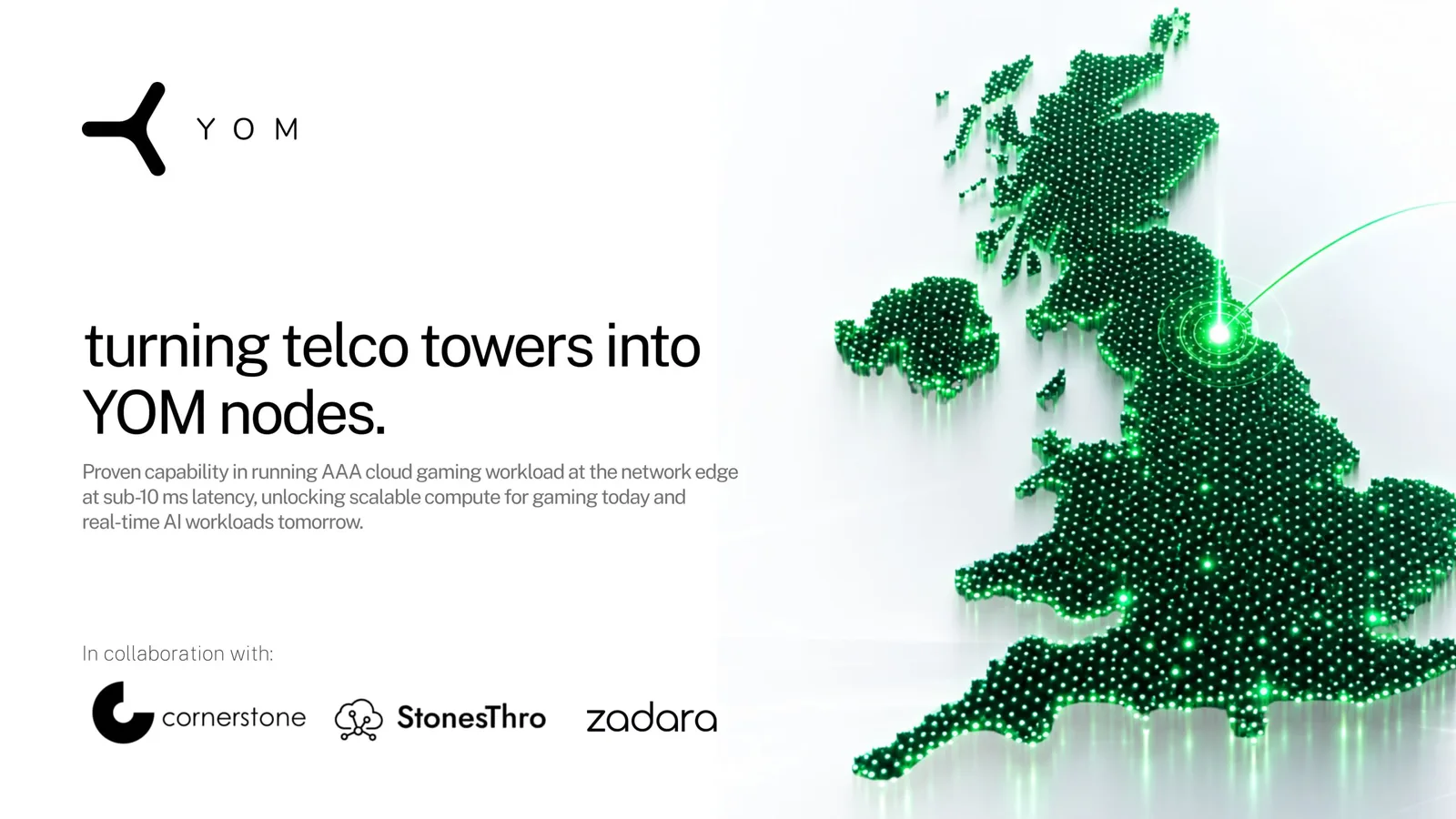
168 live AAA sessions across 20 days of continuous telemetry on UK telco sites, and one specific thing to fix before the next phase. A trial with StonesThro, Zadara and Cornerstone, the UK's largest mobile tower company.
Jeff Outlaw 2026-09-22

The token cycle: how value moves through YOM
What one session on YOM does: who places it, who serves it, what it costs by tier, and how its fee splits four ways when it settles: node operators, network development, the holders' share and the retired share.
Jeff Outlaw 2026-08-25
put your idle gaming PC on the YOM network
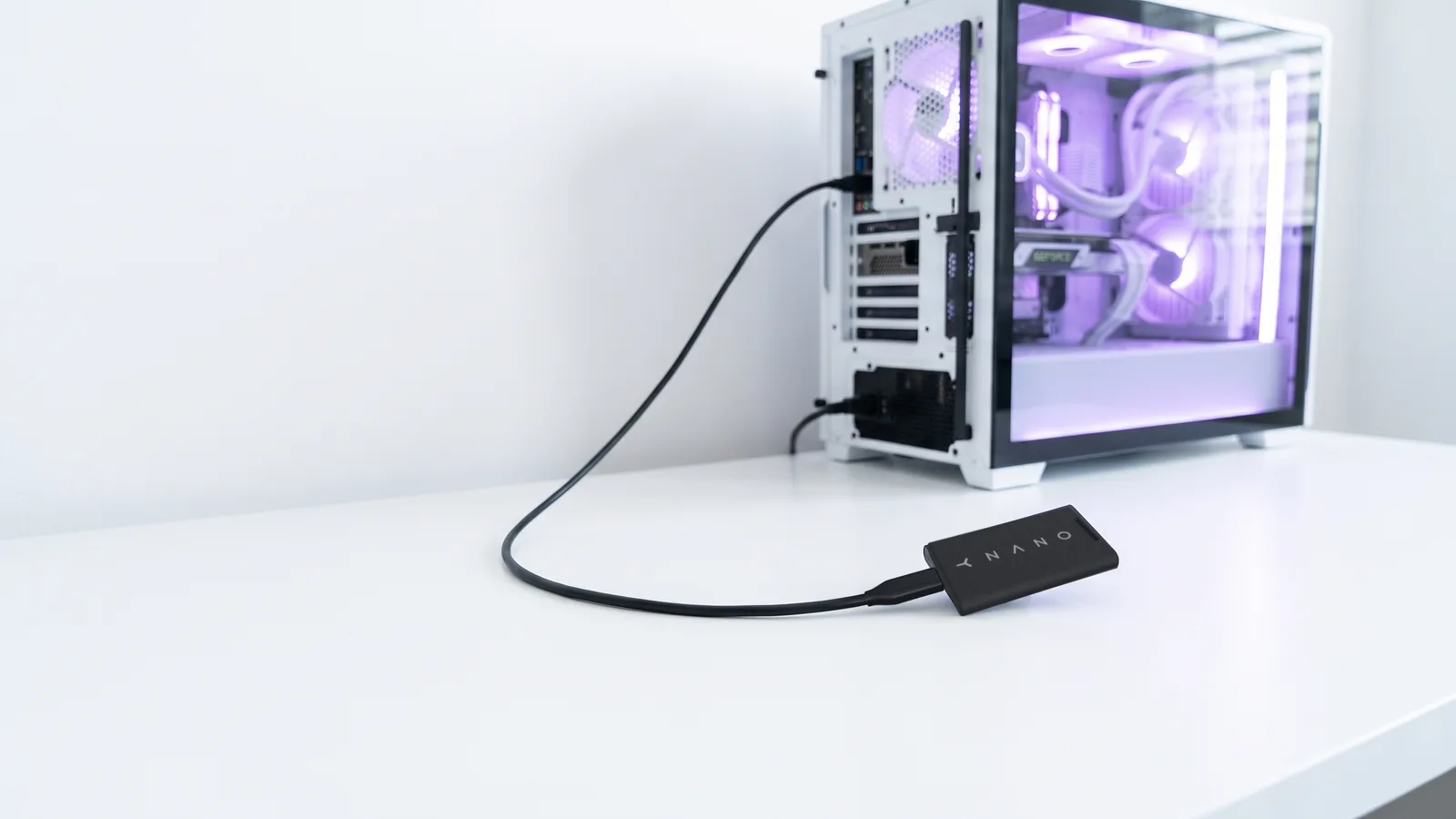
Your rig sits idle for most of the day. We're giving one gamer in our community an official YOM NANO unit so that idle time serves the network. Here's how to enter.
Jeff Outlaw 2026-08-10
a network next to the player, not a concrete bunker
Hyperscalers and neoclouds argue over who builds the bigger data centre, while Meta's Louisiana campus heads past $250 billion. For a streamed game or a live AI conversation, what decides the experience is the distance between the GPU and the user.
Jeff Outlaw 2026-07-23

cloud-native game design and the next leap
Publishers are consolidating around legacy franchises while local hardware sets the limit on design. The next new genres will be designed for the cloud, and the GPU that renders them will sit next to the player.
Jeff Outlaw 2026-07-14

AMD's Ryzen AI Halo and the edge
AMD's Ryzen AI Halo platform puts up to 96GB of graphics memory in a small desktop machine. Hardware like it is what lets real-time AI and games run on a single machine next to the user.
Jeff Outlaw 2026-06-23
the work of $YOM: what the token does
On June 5, 2026 at 10:00 AM UTC, the $YOM token went live on Avalanche. It is the unit the network settles sessions in: operators are paid in it, a share of every session fee goes to holders and a share is retired. This is what $YOM does, and why the network needed one.
Jorrit Velzeboer 2026-06-10
YOM joins the Gaming Founders Circle
Discord and Techleap picked five of the most ambitious gaming companies in the Netherlands for their new Gaming Founders Circle. YOM is one of them, alongside VaultN, Poki, MAXYMUM, and Immens.
Jorrit Velzeboer 2026-06-10

the final move: YOM mainnet is live
Today the last key piece of YOM's mainnet comes online. The settlement contract is live on Avalanche, privileged access sits behind a multisig and a 48-hour timelock, and a network that puts GPUs next to its players is switched on.
Jorrit Velzeboer 2026-06-05

the 2026 gaming shift: growth far from the data centres
3.578 billion people now play games, 61.5% of humanity. Cloud gaming nearly doubled in twelve months, and the Middle East, North Africa and Latin America grew fastest. Most of that growth is far from the data centres meant to serve it.
Jeff Outlaw 2026-06-02

YOM partners with Soneium
In May 2026 YOM partnered with Soneium, the L2 blockchain developed by Sony Block Solutions Labs, on community game nights and hackathons.
Jorrit Velzeboer 2026-05-17

YOM joins the Blockchain Game Alliance
In May 2026 YOM became a member of the Blockchain Game Alliance, an industry association of game and blockchain companies including Ubisoft, Animoca Brands, The Sandbox and Polygon.
Jorrit Velzeboer 2026-05-16

YOM joins Neo Tokyo as a Citizen
In May 2026 YOM joined Neo Tokyo, a private community of Citizen NFT holders, as a Citizen.
Jorrit Velzeboer 2026-05-15
the community round ran across three partners
From 25 May 2026 the $YOM community round ran across three partner platforms, one tranche each. A record of the round and where its terms are published.
Jorrit Velzeboer 2026-05-14
the PS6 paradox: more power, same distance
PS6 and Project Helix rumours point to Gen5 SSDs, AI upscaling and a $1,000 price tag. None of that changes the distance between a streamed game and its player, and the price tag shrinks the audience that can play.
Jeff Outlaw 2026-05-12

the edge offramp for centralized clouds
AAA titles like Call of Duty and Diablo are arriving on cloud gaming services, and every hit raises the bill for the data centres behind them. A cloud gaming service can keep its catalogue and its brand and run the sessions on GPUs next to its players.
Jeff Outlaw 2026-04-28
Luna's retreat proves the YOM thesis
Amazon's Luna has ended individual game purchases and is dropping 'Bring Your Own Library'. It is another sign that data-centre economics cannot carry an open game library, and the feature Luna dropped is the one Walter is built on.
Jeff Outlaw 2026-04-21
the source of truth on gaming economics: what a GPU hour pays for
Most of what an hour on a reserved data-centre GPU costs pays for time the GPU spends waiting for the evening peak. Here is where the money goes, and what a YOM session costs next to it.
Jeff Outlaw 2026-04-16

is the world falling out of love with traditional gaming?
IGN asked whether players are falling out of love with traditional games. Console sales are down, hardware prices are up and every game asks for a purchase and a download before the first minute of play. The problem is friction, and friction has a price.
Jeff Outlaw 2026-04-09

a strategic update on the $YOM TGE
A transparent breakdown of our decision to adjust the TGE date, driven by MiCA compliance, exchange requirements, and our commitment to launching the right way.
Jeff Outlaw 2026-03-24

YOM TGE update: here's why we're waiting
We are moving the YOM Token Generation Event (TGE). As the European Union's MiCA framework enters its strict enforcement phase this spring, we must complete mandatory compliance processes before launch.
Jorrit Velzeboer 2026-03-19
Skyrim is live on YOM, no downloads
The Elder Scrolls V: Skyrim streams in a browser on yom.net, from a GPU near the player. Open it on a computer and play, with nothing to install and no Steam account.
Jorrit Velzeboer 2026-03-16

$YOM submitted to a token data aggregator
On 16 March 2026 YOM submitted the $YOM token to a crypto data aggregator, so wallets, portfolio trackers and research tools resolve the contract address to the right name once the token is live.
Jorrit Velzeboer 2026-03-16
the $YOM token generation event
What the $YOM token is, what it does inside the network, and the facts of its launch: home chain, supply, cross-chain design and the date it went live.
Jeff Outlaw 2026-03-12

YOM partners with OKX Wallet
In March 2026 OKX Wallet onboarded YOM as a community partner, so wallet users could play games streamed to a browser from GPUs near the player.
Jorrit Velzeboer 2026-03-07
YOM through the lens of Matthew Ball
Matthew Ball's analysis of video gaming in 2026 presents a paradox: consumer spending at record levels while publisher margins compress. The industry has a cost structure problem, and part of that cost is the GPU hour.
Jeff Outlaw 2026-03-03

bridge selection results: 93.6% remained
During the token bridge selection window, participants who bridged from the legacy token chose one of three paths. The results, weighted by bridged tokens, and what each path meant.
Jeff Outlaw 2026-02-17

a strategic round led by the Avalanche Foundation
In February 2026 YOM closed a strategic round led by the Avalanche Foundation and Borderless Capital, with Outlier Ventures, CV VC, Protein Capital, Blockraise VC and Simms Capital.
Jeff Outlaw 2026-02-10

the YOM roadmap: from validation to global scale
In 2024, we shared a vision: stream games from GPUs near the player instead of from distant data centres. Going into 2026, here is the roadmap of what we had done and what came next.
Jeff Outlaw 2026-01-26

final tokenomics: from negotiation to launch
The final tokenomics configuration we are launching with. This document summarizes the structure and how each allocation maps to launch requirements, market access, and long-term execution.
Jeff Outlaw 2026-01-23

vesting and supply: the three options we offered
Getting onto a tier-one exchange meant changing the vesting terms and the supply. Here is what changed, why it changed, and the three choices early participants were given.
Jeff Outlaw 2026-01-09

YOM in 2025: from vision to velocity
2025 took YOM from concept to a live testnet, the Best Tech Startup award at Gamescom 2025 and the groundwork for mainnet. A look back at the year.
Jeff Outlaw 2025-12-22

big tech data centres: an environmental illusion
The Guardian found that Big Tech's data-centre emissions could be several times higher than reported once offset accounting is set aside. Cloud gaming does not have to grow by building more of them.
Jeff Outlaw 2025-12-12

removing the friction between players and games
Most players never reach the games they want: hardware, downloads and store accounts stand in the way. Streaming the game from a GPU near the player removes those steps.
Jeff Outlaw 2025-12-05

YOM partners with Somnia
In March 2025 YOM partnered with Somnia, a blockchain built for real-time applications, starting with a demo of streamed games during Somnia's testnet.
Jorrit Velzeboer 2025-03-13

BCG's 2025 gaming report: demand is proven, cost per hour decides
Boston Consulting Group's video game report finds that most players who tried cloud gaming liked it, and that price now shapes what they buy. The constraint moves from demand to the cost of a GPU hour.
Jeff Outlaw 2025-02-04
it all comes back to the same network
Whatever the article was about, the argument underneath it is one thing: GPU compute belongs close to the people waiting for it.