
doubling down: four months of network growth
We now have four months of network data, and there's a lot to celebrate.

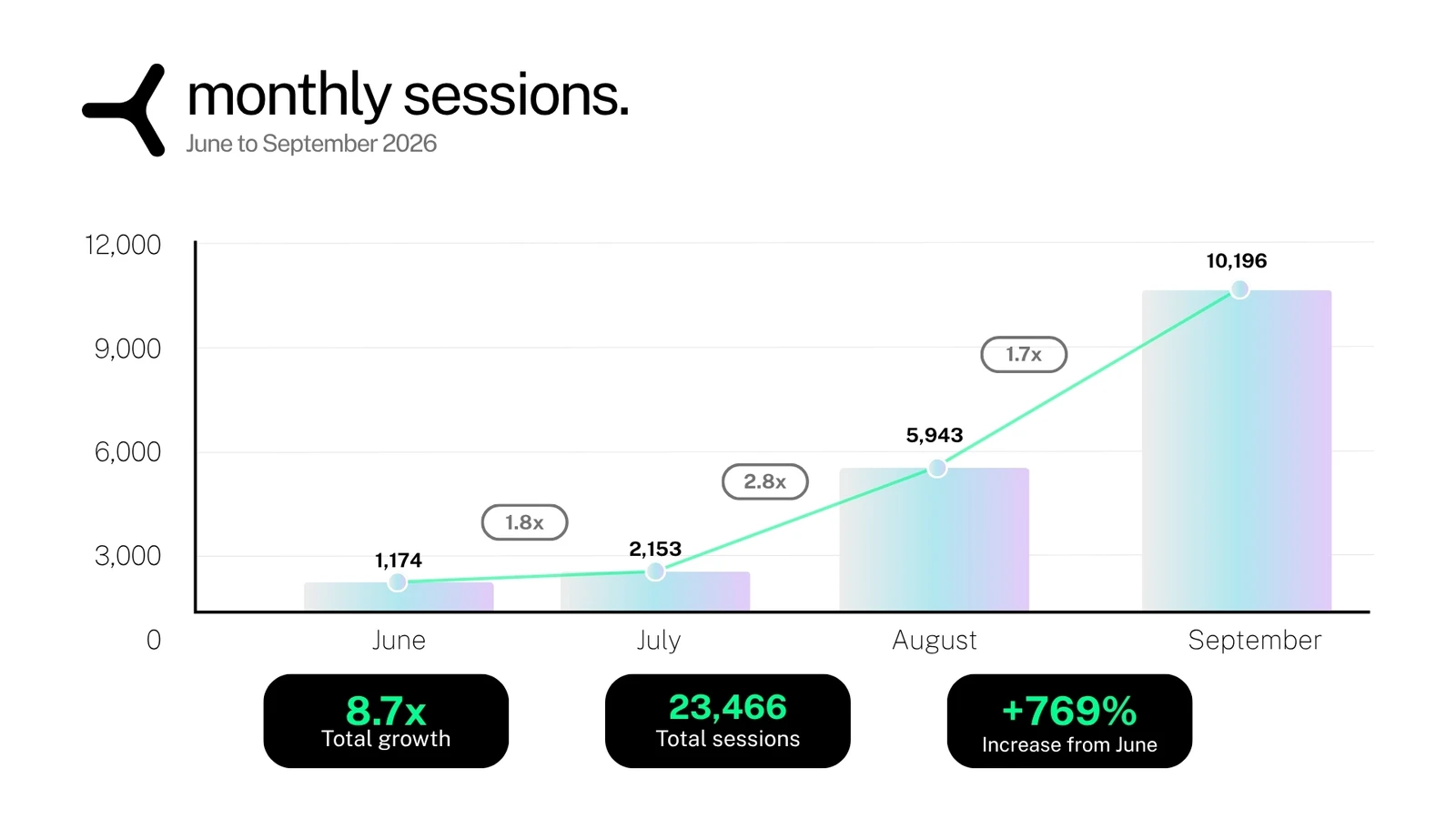
In an earlier post on antifragility, I wrote about a practice from agile game development called the retrospective. At the end of each cycle, the team asks three questions: what did we do well, where did we struggle, and what will we do about it. I suggested we all do the same, inside and outside YOM, at regular intervals, and that we start by celebrating what we did right.
It’s time to take my own advice. We now have four months of network data, and there’s a lot to celebrate.
the numbers
Here are the monthly sessions hosted on the network since June:
- June: 864
- July: 2,082
- August: 5,943
- September: 10,196
On average, sessions have more than doubled each month, and September’s total is almost twelve times June’s. September alone accounts for about 52% of all sessions the network has hosted since it went live. More than half of the network’s history happened in the last month.
what drove it
The biggest factor is Walter.gg, our consumer cloud gaming service, which lets players stream games they already own on Steam and Epic, in a browser, on any device, with no downloads.
Walter currently has only three games connected. Most of this growth came from a catalog that small.
That matters for what comes next. Every game added to Walter is another reason for a player to start a session. With the bring-your-own-game model, the catalog can grow from libraries players already own, without waiting for each game to be rebuilt for the cloud. Three games produced this curve, and each game we add gives it more to build on.
October, so far
In the first four days of October, the network hosted 3,329 sessions. That’s about 830 sessions a day, compared with an average of about 340 a day in September.
Four days isn’t a month, and early-month numbers can vary, especially when they include a weekend. But if the pace holds, October will pass September before the month is half over.
before we ‘over-celebrate’
All of these sessions come from Walter’s free alpha. None of them are paid yet. They measure usage, not revenue: real players choosing to spend their time on the network and coming back to do it again.
These growth rates also start from a small base. Doubling every month is much easier at a thousand sessions than at a million, and the pace won’t hold forever. As the numbers grow, the rate of growth will slow, which is what healthy growth looks like.
What the numbers do show is demand: players finding the service, using it, and returning, from a three-game catalog, before any marketing push from paid subscriptions.
what growth means for NANO operators
For NANO operators, growing demand is what matters most. As sessions increase, they’re routed to hosts already on the network, and that’s how utilization moves toward the network’s planned target. Today’s growth is the foundation for the paid sessions that come once Walter subscriptions and business plans go live.
The network is also built to protect existing operators as it grows. New licence batches open only when utilization reaches its threshold, so rising demand fills the machines already on the network before new supply is added.
As demand increases, the network routes sessions to operators with strong uptime first. Keeping your node reliable puts it at the front of the line.
what growth means for the project
These numbers come from a live network serving real players, not from a forecast. Together with the results from our telco tower trial, where AAA sessions ran on tower sites a few kilometers from the player, they show both sides working: the demand is showing up, and the network can serve it.
Several things should drive the next stage:
- More games on Walter, adding new sources of demand to a catalog that’s grown this much from three titles.
- Paid subscriptions, turning usage into revenue.
- YOM AI pilots, bringing live AI voice sessions onto the same network.
- Telco capacity, adding always-available, high-reliability sites alongside home GPUs.
back to the retrospective
So, the three questions.
What went well? Sessions more than doubled every month on average, from 864 in June to 10,196 in September, with more than 3,300 in October’s first four days. Our operators kept their nodes online, the team shipped Walter, and players kept coming back.
Where are we still working? Every one of those sessions came from a free alpha, the base is still small, and Walter has only three games.
What will we do about it? We’ll add more games, launch paid subscriptions, start the YOM AI pilots, and bring telco capacity online.
Then, a month from now, we’ll ask the questions again.
Correction, 9 October 2026: the first version of this post and its chart gave 1,174 sessions for June and 2,153 for July; the session ledger shows 864 and 2,082. Month on month that is 2.4x, 2.9x and 1.7x; June to September is 11.8x (+1,080%), not 8.7x (+769%); and the four months total 19,085 sessions, where the chart shows 23,466. The text above is corrected; the chart image still shows the earlier figures.
keep reading
related articles


the network under all of this
real-time work has to happen close by
About fifty kilometres from the person waiting for it. The hardware that close to people already exists, and most of it is switched off.