sign in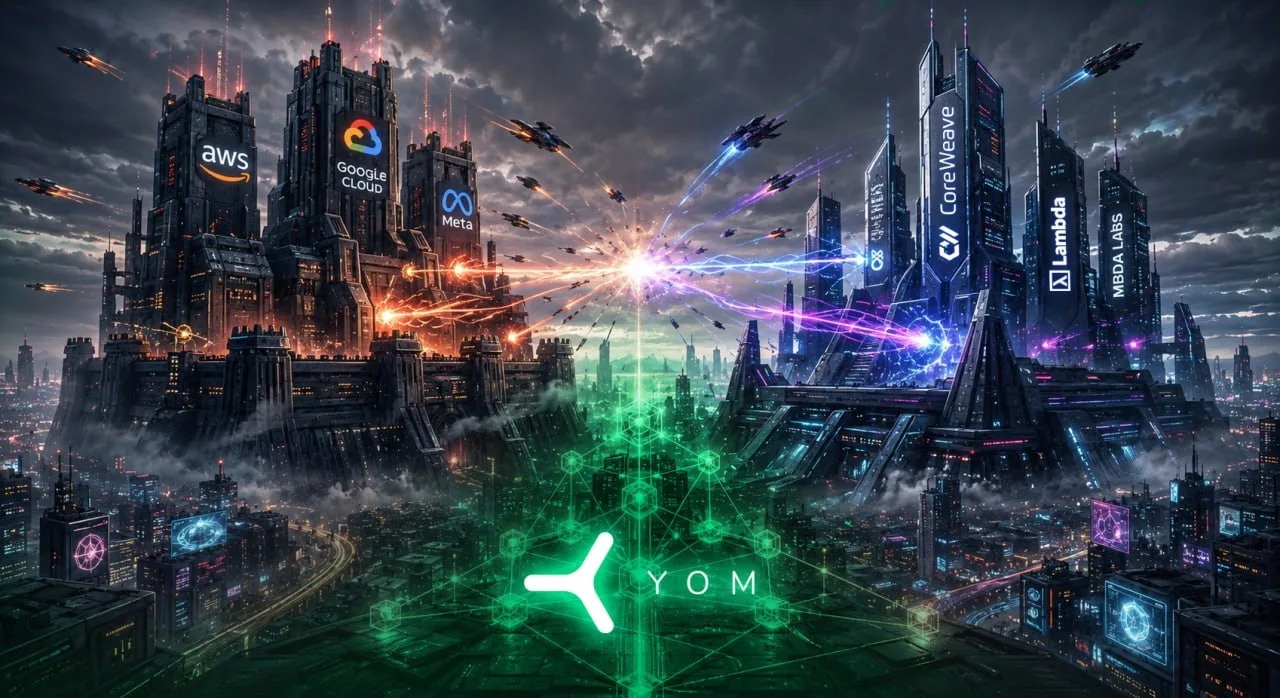

If you tuned into our latest community Town Hall, you heard us make a pretty bold claim: YOM is the world’s fastest network.
To be completely honest, we could have just as easily titled the episode “The World’s Cleanest”, “The Most Scalable”, or “The Most Resource-Efficient Network”. All of those titles fit perfectly. But the reason we can confidently back up every single one of those claims comes down to four words that are fundamentally reshaping the future of computing: decentralized GPU edge infrastructure.
While the traditional tech giants are locked in a massive, unsustainable civil war over centralized power, YOM is proving that the fastest path forward isn’t built in a centralized mega-facility. It’s distributed at the edge.
Here is why the current cloud infrastructure race is broken, and why decentralized GPU edge infrastructure is the only viable path forward.
the false dichotomy: hyperscalers vs neoclouds
A recent industry analysis by Gartner sparked a flurry of debate over the future of AI and cloud infrastructure. The media loves a good David vs Goliath story, framing the current landscape as a bitter battle between two centralized entities:
- The hyperscalers: the legacy tech titans (AWS, Google Cloud, Meta) with bottomless balance sheets trying to construct massive, all-purpose digital empires.
- The neoclouds: agile, specialized upstarts (like CoreWeave or Lambda Labs) stepping up to challenge the giants by building pure-GPU, AI-focused cloud environments.
It makes for great headlines, but it’s a false dichotomy.
Whether you are talking about a legacy hyperscaler or a trendy neocloud, both models rely on the exact same outdated architectural blueprint: massive, centralized, energy-guzzling data centers. They aren’t innovating on architecture; they are just fighting over who gets to build the bigger concrete bunker.
And those bunkers are beginning to break our world.
the $250 billion concrete bunker
To see just how absurd this centralized arms race has become, look no further than the news out of rural Richland Parish, Louisiana.
Meta is expanding its “Hyperion” data center campus to pull a jaw-dropping 5 gigawatts of computing capacity. Once you factor in the eye-wateringly expensive AI chips required to fill the site, the total price tag for this single 4,000-acre development will top $250 billion.
To put the sheer scale of a $250 billion infrastructure project into perspective, consider what else that money could buy:
- An Apollo moon mission: in inflation-adjusted dollars, the entire NASA Apollo program, which funded 11 spaceflights and put humans on the moon, cost roughly $257 billion. Meta is spending a “moon mission” budget on a single plot of land in Louisiana.
- The International Space Station: the total cost to build and design the ISS was about $150 billion. Meta could build the ISS and still have $100 billion left over for spare parts.
- A high-end PC for millions: you could buy 166 million top-of-the-line gaming rigs (at $1,500 each), enough to put a premium gaming PC in every single household in the United States and Canada combined.
the true cost to the grid
The financial cost is obscene, but the environmental strain is terrifying. This single facility will consume more power than the city of New Orleans multiplied by three. To keep the lights on, the local utility provider is forcing the construction of 10 new natural gas-fired power plants. To keep the servers cool, the site is projected to drain millions of gallons of water daily from local aquifers.
This isn’t an isolated incident. The largest power grid in the US (PJM Interconnection) is already staring down a 68-gigawatt shortfall strictly due to the relentless energy demands of centralized data centers.
We have reached the absolute limit of centralization. You cannot scale the future of digital entertainment by endlessly erecting quarter-trillion-dollar concrete fortresses that demand their own dedicated fleets of fossil-fuel power plants.
the $35 billion consumer demand shockwave
The cloud gaming market has crossed $3.8 billion and is heading toward $35 billion, while the data centres meant to serve it are running out of power.
While centralized clouds scramble to find enough electricity to exist, consumer demand is exploding.
According to a July 2026 strategic market analysis by Ken Research, the global cloud gaming market just crossed the $3.8 billion milestone and is on track to rocket to $35 billion by 2029. Driven by skyrocketing local hardware costs (the average gaming PC now clears $1,000), a massive wave of 501 million consumers will be streaming their games over the cloud within the next three years.
The report explicitly highlights the industry’s ultimate bottleneck: strategic edge network deployment.
To serve half a billion gamers simultaneously without unplayable lag, you cannot route their inputs to a mega-bunker half a continent away. Physics always wins. If a player is in London, Berlin, or Tokyo, the computing power must be physically close to them. Centralized giants are completely unequipped for true edge deployment.
the third alternative: why YOM wins
This is where YOM steps in as the third, and only logical, alternative.
YOM doesn’t build $250 billion concrete bunkers. We don’t demand new natural gas plants, and we don’t drain local water supplies. Instead, YOM’s decentralized GPU edge infrastructure activates the millions of high-end, top-tier gaming GPUs that are already sitting in people’s living rooms, idle for 80% of the day.
By creating a globally distributed mesh network of near-premise nodes, YOM achieves exactly what the market is begging for:
- The world’s fastest network: because our node operators are located in the very neighborhoods, cities, and regions where the players live, we bypass the traditional data center bottlenecks entirely, delivering native sub-12ms latency for AAA cloud gaming.
- The world’s cleanest network: we practice computational repatriation. By utilizing existing, distributed hardware, YOM expands global cloud capacity with zero new concrete and zero additional strain on a fragile power grid.
- The world’s most scalable network: when a centralized provider needs to scale, they must negotiate for years, secure billions in tax breaks, and build physical facilities. When YOM needs to scale, our protocol simply incentivizes more local node operators to spin up their rigs, instantly expanding the network’s footprint.
the future is distributed
The alternative to a quarter-trillion-dollar data centre is a network of GPUs that were already bought and are already powered.
The hyperscalers and neoclouds can continue fighting their 20th-century war of attrition over land, water, and fossil fuels. Meanwhile, YOM is quietly building the actual future of the 3D internet.
We aren’t spending a quarter-trillion dollars to build a centralized bottleneck. We are coordinating the hardware the world already owns to turn the entire planet into a decentralized supercomputer.
Want to help us build the world’s fastest network? Head over to YOM.net to discover how you can spin up a node, contribute your idle GPU cycles, and earn rewards powering the future of cloud gaming.