
the 2026 gaming shift and why DePIN wins
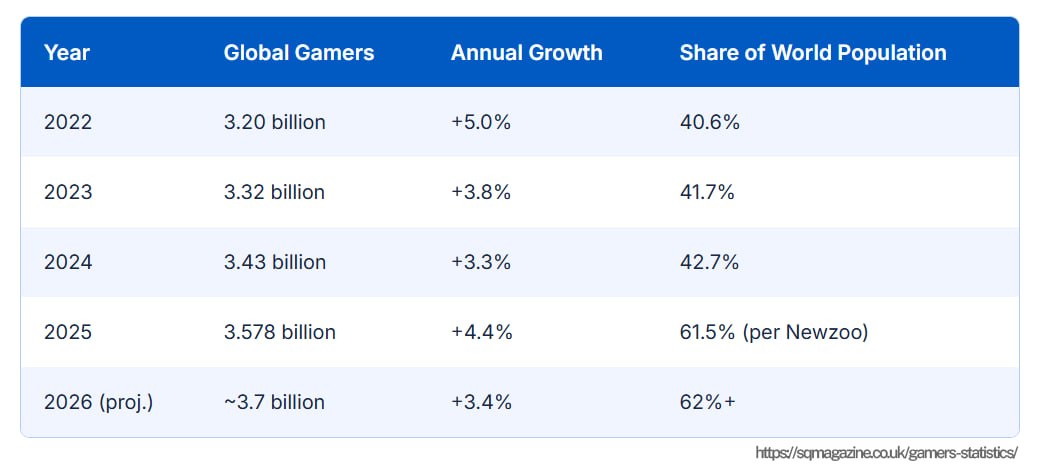
3.578 billion people now play games, 61.5% of humanity. Cloud gaming doubled in twelve months while MENA and Latin America became the fastest-growing regions. Here's why centralized infrastructure can't scale to the edge, and why DePIN can.


Figures in this post are as of 2 June 2026. Current network figures are on source of truth.
The landscape of global gaming has completely transformed. If you still view gaming as a niche pastime restricted to expensive hardware and localized console setups, the latest market data is here to clear that misconception.
According to SQ Magazine’s recently published Gamers Statistics report, the global player base has skyrocketed past a historic milestone: 3.578 billion people are now active gamers. That represents an astonishing 61.5% of humanity, driving an industry on track to breach $205 billion this year.
At YOM, this data doesn’t just represent impressive numbers, it is the ultimate validation of our business model, our architecture, and our timing. The old guard of centralized gaming infrastructure is cracking under the weight of this massive expansion.
the realities of an omnipresent addressable market
Gaming now reaches 3.578 billion people, so cloud delivery is no longer a niche inside entertainment but a mainstream distribution problem.
The sheer scale of today’s gaming population means that digital entertainment is no longer an isolated market segment; it is a foundational pillar of human connectivity. With more than 150 million new players entering the fold annually, the traditional distribution loops we see, monolithic app stores, heavy digital downloads, and ecosystem lock-ins, are actively slowing down consumer onboarding.
The YOM Vision: We believe that accessing a AAA-quality gaming experience should be as frictionless as loading a webpage. YOM’s decentralized architecture enables publishers to embed high-fidelity AAA experiences natively into any browser, social link, or messaging app such as Telegram. By eliminating the friction of downloads and platform entry barriers, YOM provides the rail system needed to activate the 3.5+ billion omnipresent players who expect instant utility.
the cloud gaming boom meets the local hardware wall
One of the most telling insights from the 2026 data is the explosive growth of cloud streaming. The cloud gaming market nearly doubled in twelve months, jumping from $7.0 billion to $11.1 billion. Microsoft disclosed a massive 45% year-over-year increase in streaming hours, but the real breakthrough statistic lies under the hood: more than one-third of all cloud gaming sessions originated from devices that are completely incapable of running the software locally.
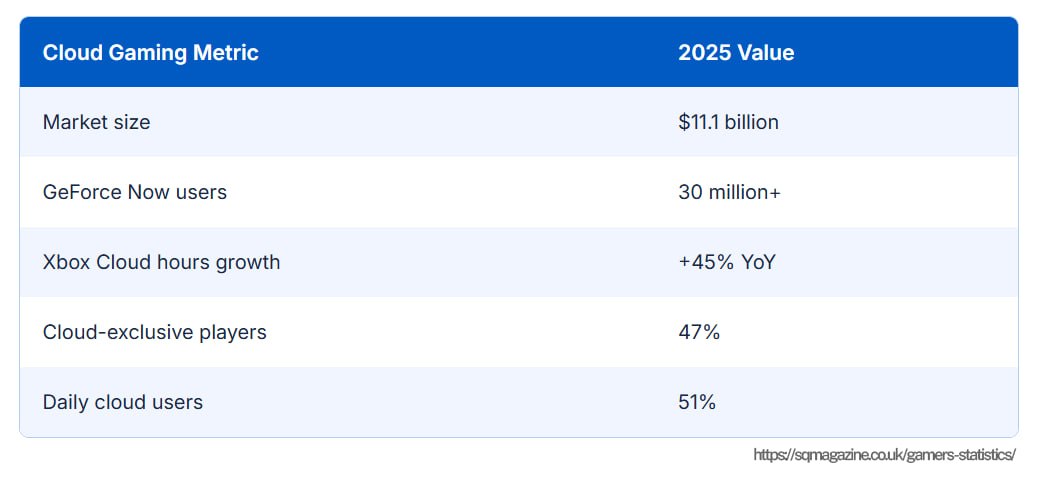
Consumers want high-end, immersive worlds, but they are hitting a financial and technological brick wall when it comes to upgrading local PCs or buying new hardware.
The YOM Vision: While the demand for cloud gaming is undeniable, legacy cloud providers rely on hyper-centralized, capital-intensive data centers. The infrastructure overhead is massive, making it impossible to scale down pricing for mass adoption. YOM completely flips the economics of cloud streaming. By utilizing a Decentralized Physical Infrastructure Network (DePIN), we eliminate data center overhead entirely. A session runs on a per-session fee from $0.04 (Light) to $0.24 (Ultra): a Standard session of up to an hour costs $0.08, against about $1.23 for the same hour on a data-centre GPU reserved for the peak. We aren’t just making cloud gaming available; we are making it economically viable for the masses.
serving hyper-growth markets at the edge
The fastest-growing gaming regions are the Middle East and North Africa (MENA) and Latin America, and serving them needs GPUs near the player rather than in a distant data centre.
The geographic center of gravity for gaming has permanently shifted. Mature Western markets like North America and Europe have slowed down to a modest ~2.3% annual growth. Meanwhile, emerging regions are exploding: the MENA (Middle East and North Africa) region posted a stellar 6.8% year-over-year growth rate, closely followed by Latin America at 5.3%.
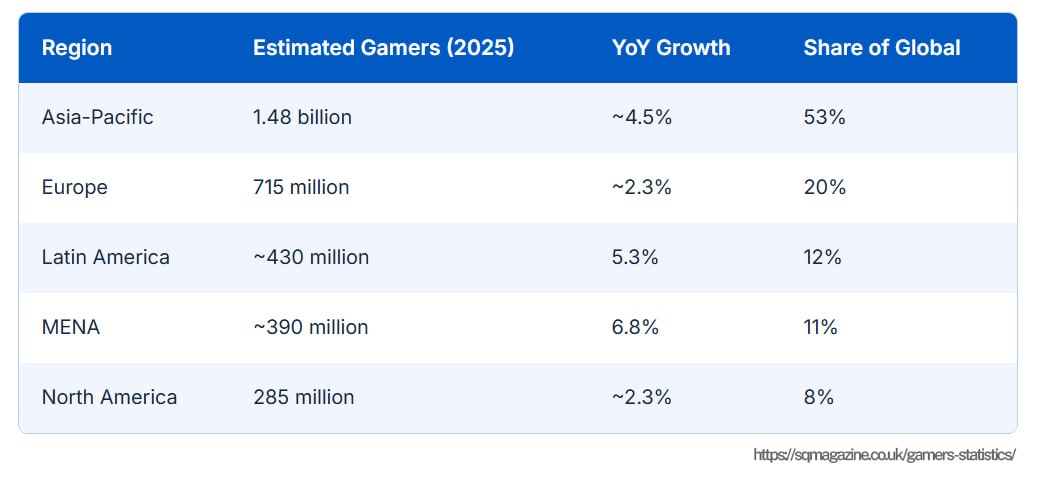
In these fast-expanding territories, high-end console and PC hardware is economically prohibitive. Furthermore, centralized cloud infrastructure fails these players due to physical distance, data centers are generally not located nearby, so latency issues render fast-paced games completely unplayable.
The YOM Vision: Centralized networks can’t scale to the global edge, but DePIN can. YOM runs on a distributed network of local node operators, everyday users putting the idle compute power of their personal gaming rigs to work. When a player in MENA or Latin America boots up a title running on YOM, HyperOrch, YOM’s edge orchestrator, sends the session to the nearest node with the GPU capability and free capacity it needs. This architecture targets a sub-10 ms median latency for players within 50 km of a node (measured live on yom.net/source-of-truth), opening premium AAA experiences for the world’s fastest-growing gaming populations.
fueling 444 billion hours of play with GPU supply that grows with demand
Cumulatively, humanity spent an unthinkable 444 billion hours playing video games over the past year. Heavy gamers, representing the top 10% of the player base, routinely cross more than 20 hours of playtime every single week. To render, stream, and compute this unfathomable amount of high-fidelity activity, the global demand for distributed GPU cycles is reaching a boiling point.
The YOM Vision: The core bottleneck of the next decade won’t be game design, it will be raw computational supply. YOM solves this global GPU constraint by incentivizing the crowd. Operators are paid 60% of every session fee their GPU serves, a fixed share set in dollars and paid in $YOM. We are creating a self-sustaining, circular economy where the global surplus of processing power directly fuels the hundreds of billions of hours demanded by modern players.
the road ahead
For a DePIN network like YOM, SQ Magazine’s 3.578 billion players and $205 billion in revenue mean the demand side of the equation is already solved.
The data confirms that the old stereotypes of the gaming industry are dead. The market is now defined by billions of users demanding frictionless, high-fidelity experiences that cross borders and surpass local hardware limits.
The industry is at a transformational junction with the growth of the player base and the rise of cloud gaming. At the scale of this transformation, legacy infrastructure will not keep pace, and new technologies will complete the revolution. By combining decentralized edge networks with radical cost efficiencies and node economics paid by real sessions, YOM is building the definitive foundation for the future of interactive entertainment.
About YOM
YOM runs the session edge: GPU capacity next to every user, sold per session from $0.04, for games and live AI. YOM is backed by Outlier Ventures, Borderless Capital, the Avalanche Foundation, Protein Capital, CV VC, Blockraise VC and Simms Capital. It won Best Tech Startup at Gamescom 2025 and is a member of NVIDIA Inception.
keep reading
related articles


the network under all of this
real-time work has to happen close by
About fifty kilometres from the person waiting for it. The hardware that close to people already exists, and most of it is switched off.