
from slots to capacity: every license becomes two
Every license you hold becomes two, every NANO includes two licenses, and a new license costs $125. Here's how capacity, sessions and licenses work.

We’re changing how the network counts a machine’s power, and it comes with news for license holders. When the licensing system goes live, planned for the first quarter of 2027, every license you hold becomes two and every NANO includes 2 licenses. Why? A new license will cost $125, half the previous price. Until then, your machine runs and is paid exactly as it is today. This post covers what changes: capacity, what each session pays, what licenses do, and what a machine can earn.
from slots to capacity
Until now we counted machines in slots, one slot being one Standard session. Slots are gone. We now count capacity: how much of a machine’s power the network can put to work at once.
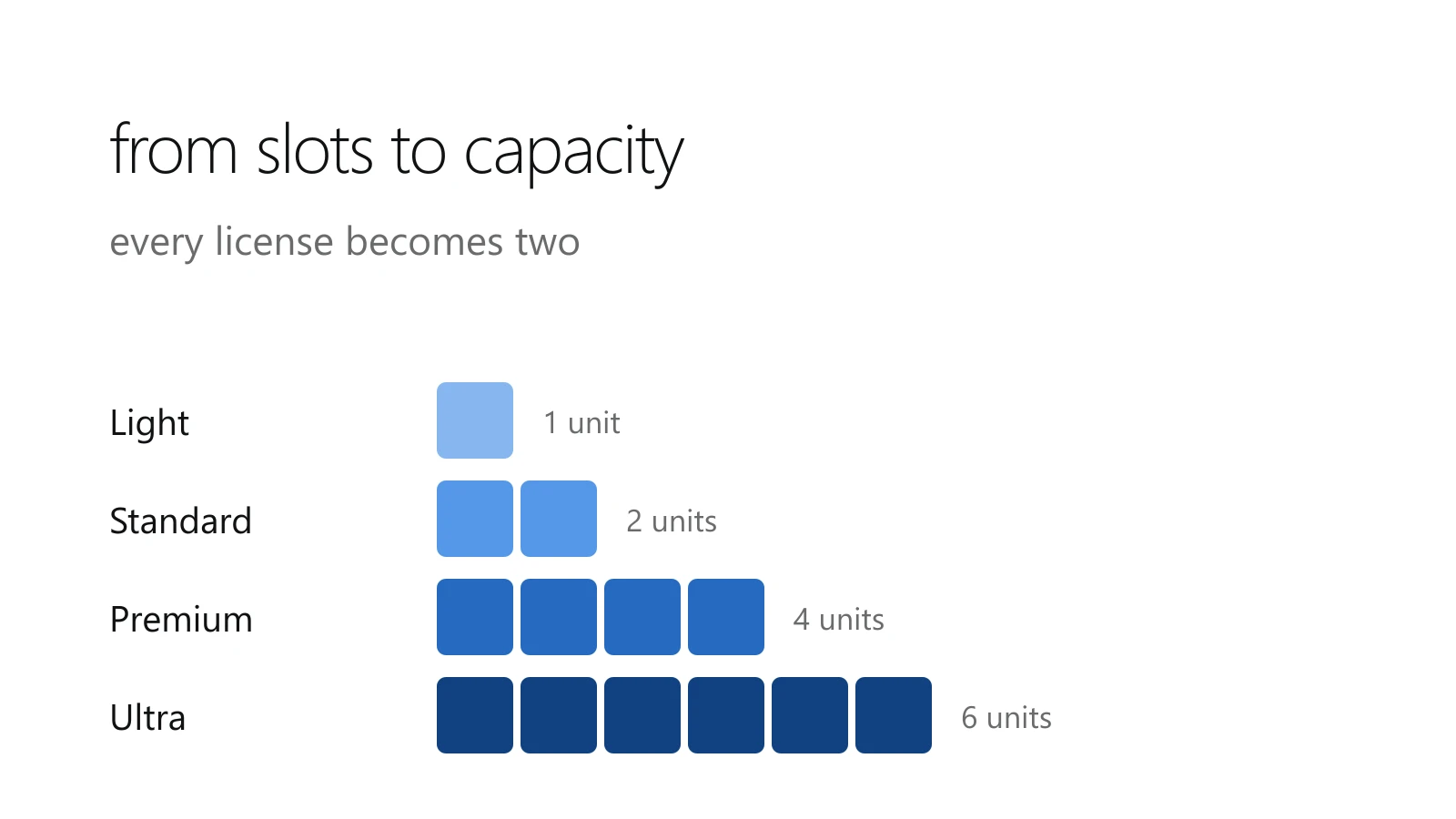
Capacity is measured in units. One unit is what a Light session needs, so every session size is a whole number of units:
| Session size | Typical games | Capacity used |
|---|---|---|
| Light | Mobile and 2D games | 1 unit |
| Standard | Most PC games | 2 units |
| Premium | Open-world AAA games | 4 units |
| Ultra | The heaviest games and live AI | 6 units |
Your graphics card, processor, memory and upload speed set your machine’s capacity, and the free rig check measures it. A machine can serve any mix of sessions that fits.
what each session pays
Every session pays a fee set by its size, and 60% of it goes to the operator whose machine served it:
| Session size | Session fee | You receive (60%) |
|---|---|---|
| Light | $0.04 | $0.024 |
| Standard | $0.08 | $0.048 |
| Premium | $0.16 | $0.096 |
| Ultra | $0.24 | $0.144 |
Every unit of capacity pays the same, $0.024 per session, so you’re paid for the capacity your sessions use. A session lasts up to 60 minutes. The rest of each fee goes 30% to the network and 5% to the staking pool, and 5% is burned.
Each game is assigned a size; you don’t choose it. Until every game has its size set, sessions pay at the Standard rate.
licenses unlock capacity
When the licensing system goes live, a license unlocks one unit of capacity. Your machine serves up to its own capacity or the capacity its licenses unlock, whichever is lower.
Licenses limit how much of your machine is in service, never how many players it serves. With 5 licenses, a machine can serve one Premium and one Light session at the same time, or two Standard and one Light, or five Light.
There’s no cap on how many licenses a machine can use. A more capable machine has more capacity, and every license you add puts one more unit of it to work.
what changes for you
All of this takes effect when the licensing system goes live, planned for the first quarter of 2027:
- Every license becomes two. Every license is reissued on Avalanche, and you receive two new licenses for each one you hold. Your capacity stays the same: one old license covered a Standard session, and two new ones cover the same. Keep your licenses in your wallet; we’ll announce the exact date in advance.
- Every NANO includes 2 licenses, enough for one Standard session. This applies to every NANO, including the ones already running.
- Licenses unlock capacity. Each machine serves the capacity its licenses unlock, and every license you add puts more of it to work.
A new license costs $125, half the previous price, so the same capacity costs the same. New licenses open in batches as network demand grows. You don’t need to do anything.
what a machine can earn
Three examples, from an entry-level gaming PC to a maxed-out one. Earnings use the fees above, sessions of a typical length, and the network’s target: a machine busy half the time.
Entry
RTX 3060, 8 GB
- Capacity
- 2 units
- Licenses
- The NANO's 2
- Cost
- $349
- Target: Busy half the time
- ~$53 a month
- Pays back in
- ~7 months
Mid-range
RTX 4080, 16 GB · 32 GB RAM · 100 Mbps upload
- Capacity
- 6 units
- Licenses
- The NANO's 2 + 4
- Cost
- $849
- Target: Busy half the time
- ~$158 a month
- Pays back in
- ~5.4 months
Maxed out
RTX 5090, 32 GB · 32-thread CPU · 64 GB RAM · 200 Mbps upload
- Capacity
- 16 units
- Licenses
- The NANO's 2 + 14
- Cost
- $2,099
- Target: Busy half the time
- ~$420 a month
- Pays back in
- ~5 months
The maxed-out RTX 5090 is full at 16 units, for example four Premium sessions, or two Ultra and two Standard. At that point its graphics memory, processor and memory are all in use. A second graphics card, more memory or faster upload adds capacity, and room for more licenses.
Each extra license pays itself back faster than the NANO: $125 unlocks one unit, which earns ~$26 a month at half-busy demand, so it pays back in under 5 months.
These figures are before electricity. A maxed-out RTX 5090 machine draws about 0.8 kW at full load; busy half the time, that is about $55 a month at $0.17 per kWh, or about $100 at $0.30.
These are estimates, not guarantees. A machine earns only while it serves sessions, so earnings follow demand in your area, your uptime and your hardware. The network is still growing toward the half-busy level, so earnings today are lower. The Operator App shows your real numbers, and those are the ones to go by.
the monthly bonus
The monthly bonus stays as it is: $74 per NANO each month, on top of what your sessions earn. $37 is guaranteed when your machine is online at least 6 hours a day. The other $37 goes into a shared pool, split by the sessions each machine serves. It stays in place until a better subsidy system replaces it, and we’ll announce that in advance.
FAQ
Is my machine earning less?
No. Until the licensing system goes live it serves the same sessions and is paid as before. After that, a NANO’s two licenses cover one Standard session, and extra licenses let a capable machine earn more.
I hold licenses but don’t run a machine. What changes?
Your count doubles like everyone’s. A license earns when it unlocks capacity on a machine that serves sessions.
How many licenses can my machine use?
As many as its capacity in units. Run the free rig check to see yours.
Which session sizes will my machine serve?
Any that fit its capacity, from the games assigned to it. You don’t pick games or sizes.
keep reading
related articles
the network under all of this
real-time work has to happen close by
About fifty kilometres from the person waiting for it. The hardware that close to people already exists, and most of it is switched off.