
the YOM roadmap: from validation to global scale
In 2024, we shared a vision of a better way to distribute games. Rolling into 2026, here's a roadmap that broadcasts all that we have accomplished and all that is coming.
Figures in this post are as of 26 January 2026. Current network figures are on source of truth.
In 2024, we shared a vision of a better way to distribute games, a cloud gaming network that does not rely on expensive, inefficient data centers but instead uses all of the advanced technologies available to create a Decentralized Physical Infrastructure Network (DePIN) for gaming.
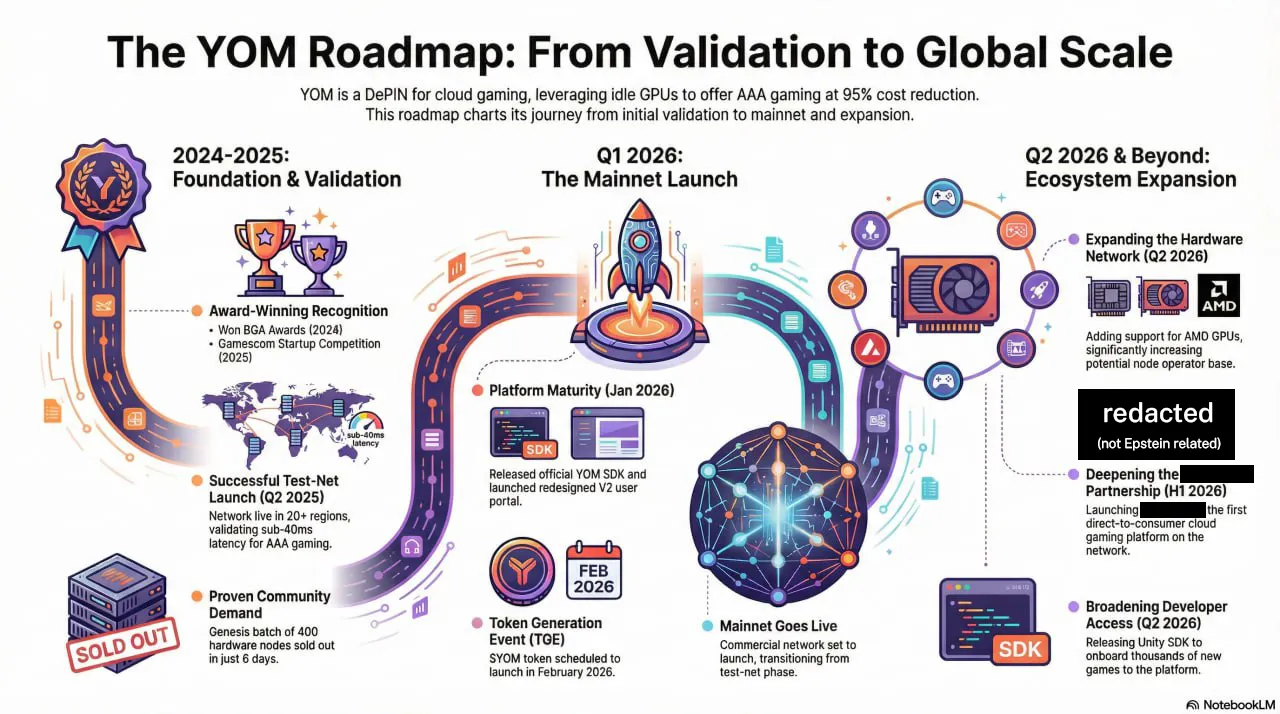
Rolling into 2026, we thought it would be helpful to create a quick info-graphic that broadcasts, both internally and externally, all that we have accomplished since then and all that is coming. We’ve talked often about our mentality since that launch, validation → mainnet launch → expansion. We knew from the beginning that we were in for a marathon and that mile markers were going to be important. Now we have a visual to accompany us on our journey.
industry and commercial validation
The validation behind the YOM roadmap is a Blockchain Game Alliance award, the Best Tech Startup award at Gamescom 2025 and a 19-region testnet.
Here are the highlights of our road to validation, both from the gaming industry and the gaming community, and the technology that made the validation inevitable.
- Awards: Blockchain Game Alliance (BGA) Award, 2024, and the Best Tech Startup award at Gamescom 2025
- Technology: Testnet launch across multiple regions
- Accessibility: Streaming AAA game content via any URL and in both Telegram and Discord
- Commercial: the first NANO batch sold out in two days; Rig Check app live, with the count of scans and regions on /source-of-truth
mainnet launch in q1
This brings us to Q1 of 2026, where Mainnet goes live and we transition from the test phase into launch. So much technology has rolled out at the end of last year and in this first quarter to make this possible, supported by so much business development to make our launch titles successful.
Key Advances will include:
- Universal Pixel Streamer SDK released
- HyperOrch(™) orchestrator live
- $YOM Token Generation Event (TGE)
- NANO operator portal V2 live
2026 (h1 to q2) and beyond: ecosystem expansion
After mainnet, the YOM roadmap widens GPU vendor support so more kinds of hardware can join the network.
Expansion is what follows as we move into Q2 and beyond.
The new quarter means an expansion of our GPU support layer. There is a drive to broaden GPU vendor support on the network for greater supply and to lower the constraints on NANO ownership.
In addition, we expect a Unity specific SDK release will attract those titles who want to take advantage of Unity specific features not available in the Universal Pixel Streamer.
Finally, there is a proposal on a yet-unannounced platform that will serve as a commercial facing end to demonstrate the power, and efficiency, of our infrastructure technology. Stay tuned, more to be revealed.
moving forward in 2026 and beyond
With validation complete and Mainnet launching, our focus now shifts to ecosystem scaling. Here’s how you play a role:
- Test your system to see what your PC can host with our Rig Check app
- Join us in our socials to keep abreast of our progress
- Share this roadmap far and wide as we build towards mainnet
We are changing the way games reach players with a decentralized network built specifically for real-time streaming, at a fraction of data-centre cost. Doing this means that we’ve fixed cloud gaming. Seriously.
FAQ
When did the YOM mainnet launch?
Mainnet went live on 5 June 2026, together with the $YOM Token Generation Event (TGE).
What is the YOM TGE?
The YOM Token Generation Event is the launch of the $YOM token, the unit the network meters and settles each session in.
How can I participate in the YOM network?
You can become a NANO operator by running a node, or use the Rig Check app to see what your system can host.
keep reading
related articles
the network under all of this
real-time work has to happen close by
About fifty kilometres from the person waiting for it. The hardware that close to people already exists, and most of it is switched off.